By Jannis Kostelnik
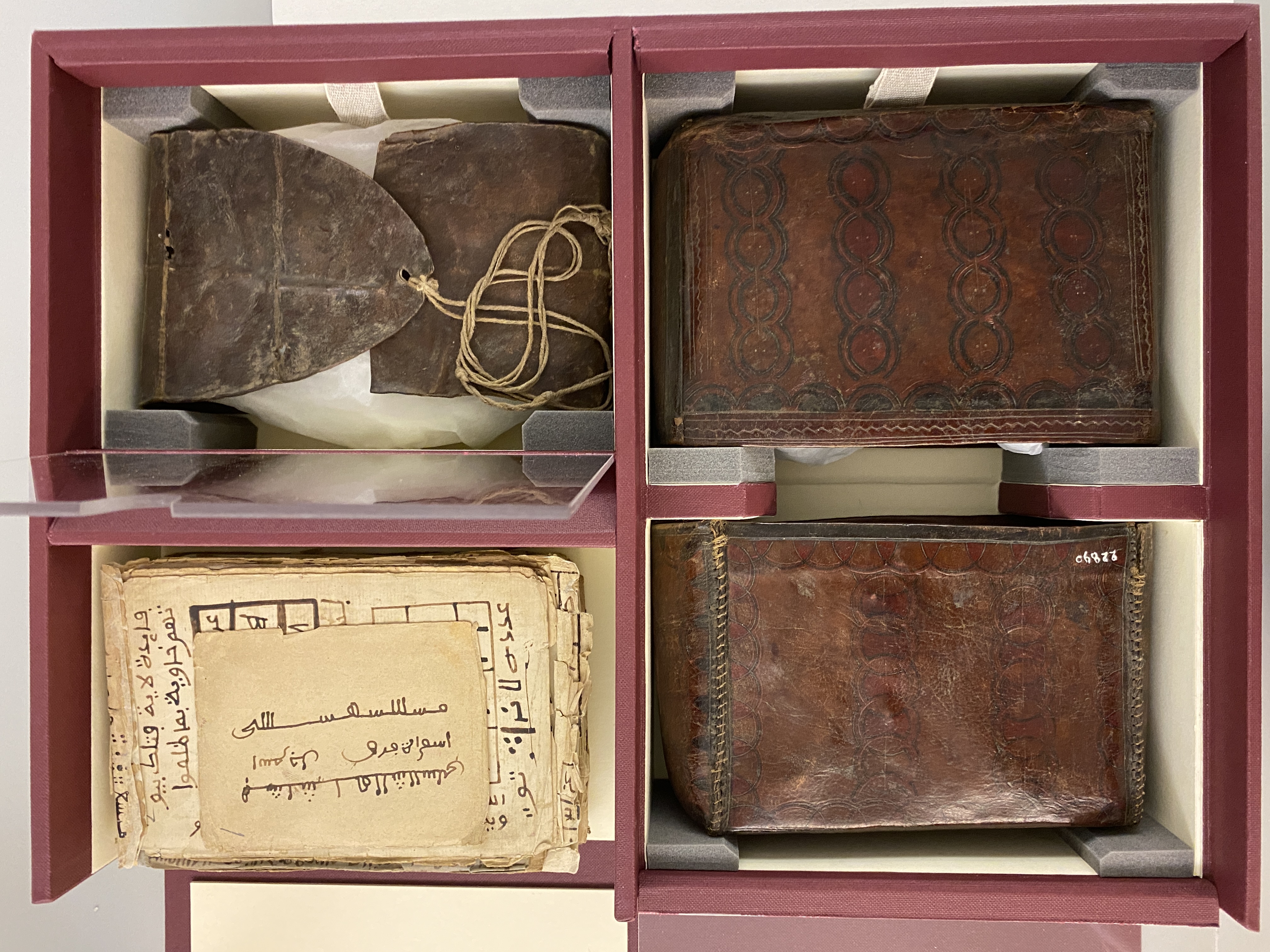
In the first part of ‘Britannia in Blue’, I have presented a number of blue folios found in a West African manuscript housed at the Wellcome Collection, London, and discussed the history of blue paper in Europe and the Islamic world, as well as the importance of European paper for West African manuscript cultures. In this second part, we will try to identify the folios’ manufacturers via their watermarks; take a short look at the folios’ contents; and conclude our expedition into the phenomenon of blue paper in West African manuscript culture by speculating on its cultural significance.
We can assume that the manuscript WMS Arabic 742 was created after 1890; one of the pre-printed pages came from a memorandum book and features the date placeholder 189_. All of the blue paper in the manuscript must therefore have been industrially produced by adding colourants to the pulp early in the production process – a technique greatly facilitated by the emergence of synthetic and aniline-based dyes in the nineteenth century.
Unfortunately, only two of the blue bifolios (four double-sided leaves) in WMS Arabic 742 are watermarked. They were once part of a single larger sheet which has been cut. The edges have subsequently been trimmed. Nonetheless, the sheets can easily be put together again to reveal a design showing a seated figure (Fig. 2).
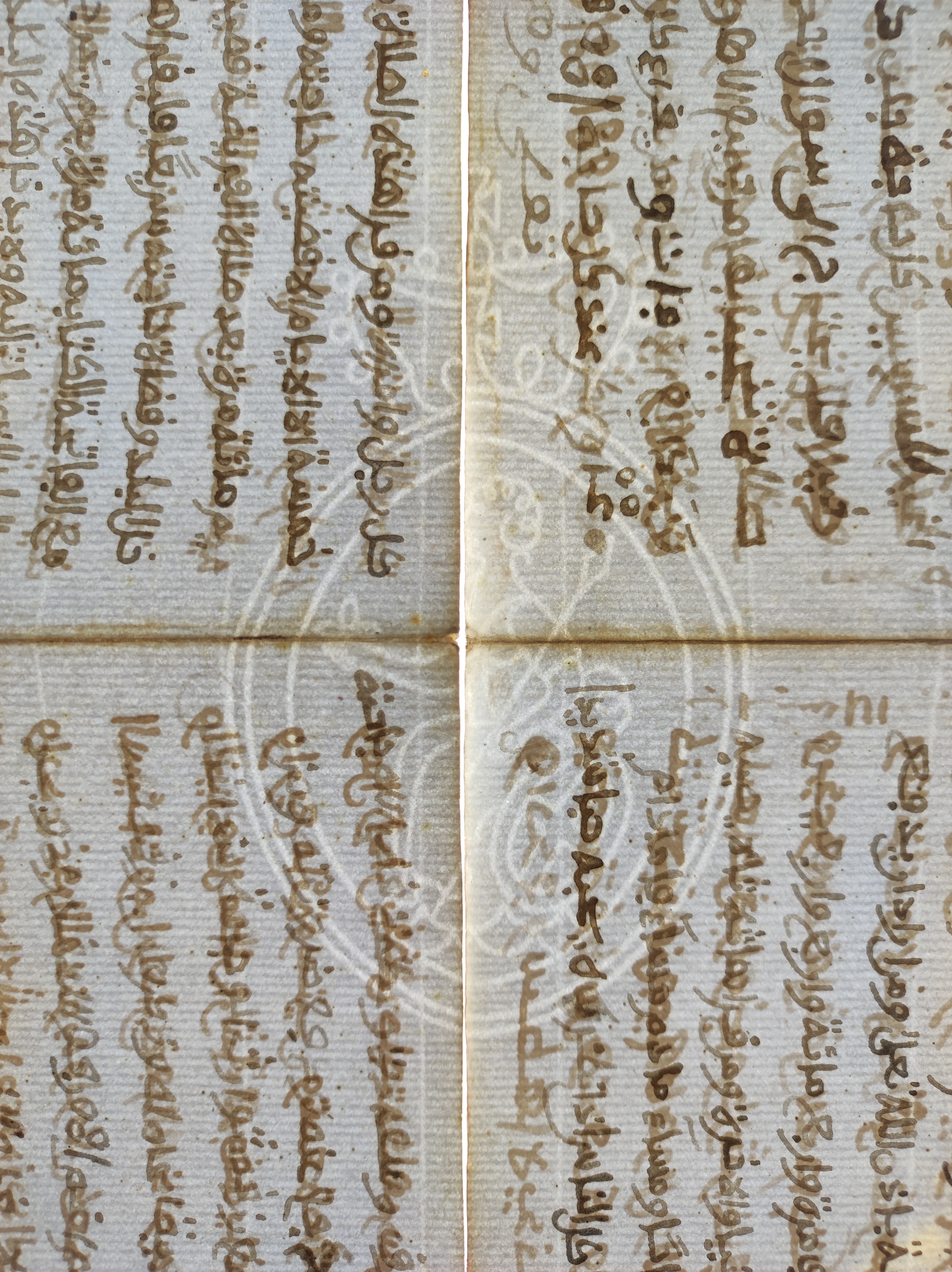
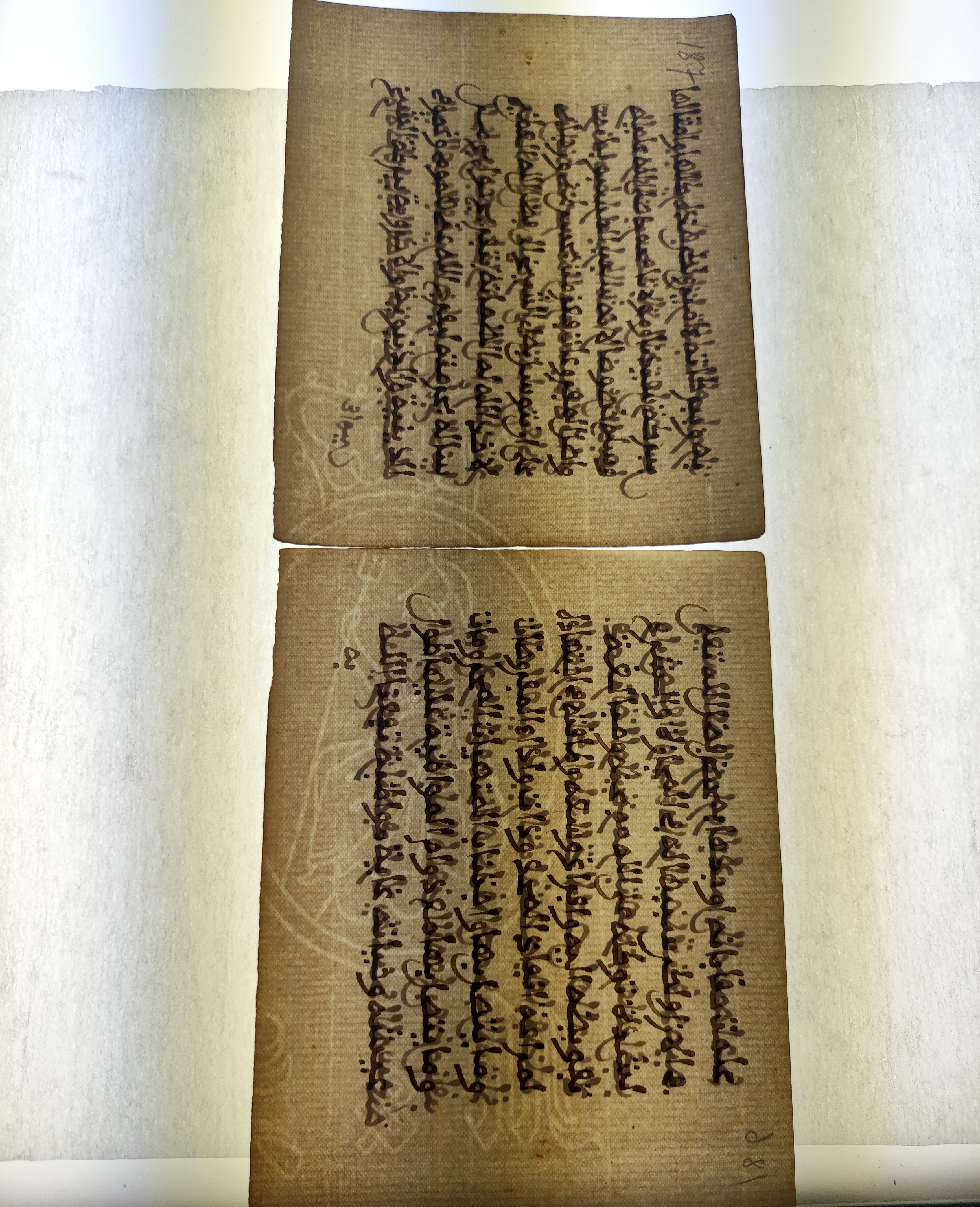
This was a very common design in British watermarks in the eighteenth and nineteenth centuries. The seated woman is Britannia, the allegorical figure symbolising the British Empire, usually shown with a shield by her side and various attributes around her – in this case, a sceptre and an orb adorned with a cross. Sometimes watermarks included additional information, such as the paper mill’s name, address or initials, or the common motto ‘Pro [Rege et] Patria’ (‘For [King and] Fatherland’). Since nothing like that is present here, the watermark is hard to identify definitively, but it bears close resemblance to one used in the nineteenth century by Edward Towgood of Sawston, Cambridgeshire. Another variation of the Britannia watermark occurs on a different (non-blue) bifolio in the manuscript (Fig. 3), identifiable as the watermark of Millington & Sons, Budge Row, based on the initials M&S and the countermark reading ‘Budge Row Foolscap 31&32’. Paper from both manufacturers is known to have been used in West Africa, as Darya Ogorodnikova has identified watermarks from both in a manuscript from Sierra Leone, now housed at the Bibliothèque Municipale in Tours, France (Ogorodnikova, 2023).
The popularisation of blue stationery in Britain coincided with the processes leading to the empire’s greatest expansion, such as the Great Game in Asia and the Scramble for Africa. Unsurprisingly, researchers often encounter such stationery in post sent to and from British agents, including ones stationed in the remotest parts of the world. The Library and Archives of the Royal Botanic Gardens, Kew, hold an especially beautiful example – the watermark discernible even without transmitted light – from the 1870s correspondence of the missionary Thomas Powell, who was based on the Samoan island of Upolu. According to Adam Gacek, blue paper was also commonly imported from Russia to Iran for manuscript purposes around the same time (Gacek 2009). By the 1890s, blue paper was in wide use around the world for various kinds of postal stationery. For example, George Vella points out that letter cards made from blue paper, similar to postcards but without an image, became a cheaper alternative to letters (Vellla 2018). Later, aerogrammes and air mail letters were also made from blue paper.
We therefore shouldn’t be surprised to find blue paper commonly used in the West African colonies in the early 1890s, especially for everyday activities like correspondence and writing for private purposes. Blue paper use was not limited to the echelons of imperial bureaucracy; for example, it was also used by missionaries, who would have had closer contact with the local population. Through these channels, local actors like the scribe(s) of WMS Arabic 742 could have easily come to possess blue stationery paper.
In my article for the Journal of the German Oriental Society, I noted that the imported blue paper may have reminded West African literati of the high-quality coloured paper of the golden age of Islamic manuscript culture (Kostelnik 2026), such as the famous North African Pink Qur’ān, discussed in Umberto Bongianino and Éléonore Cellard’s recent work (2025). That is pure speculation, however; West African scribes may have simply liked the look of blue paper, just as European consumers did.
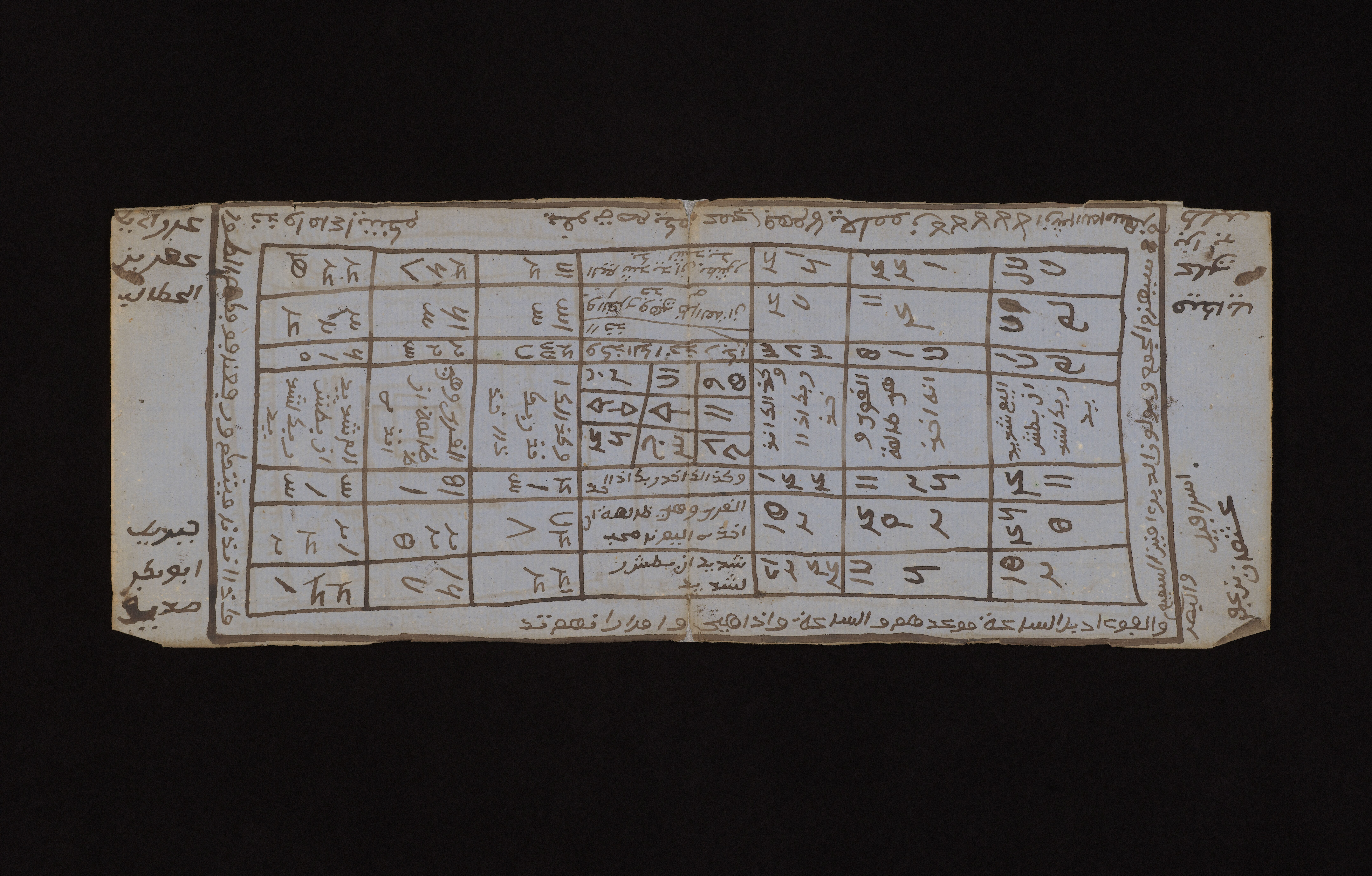
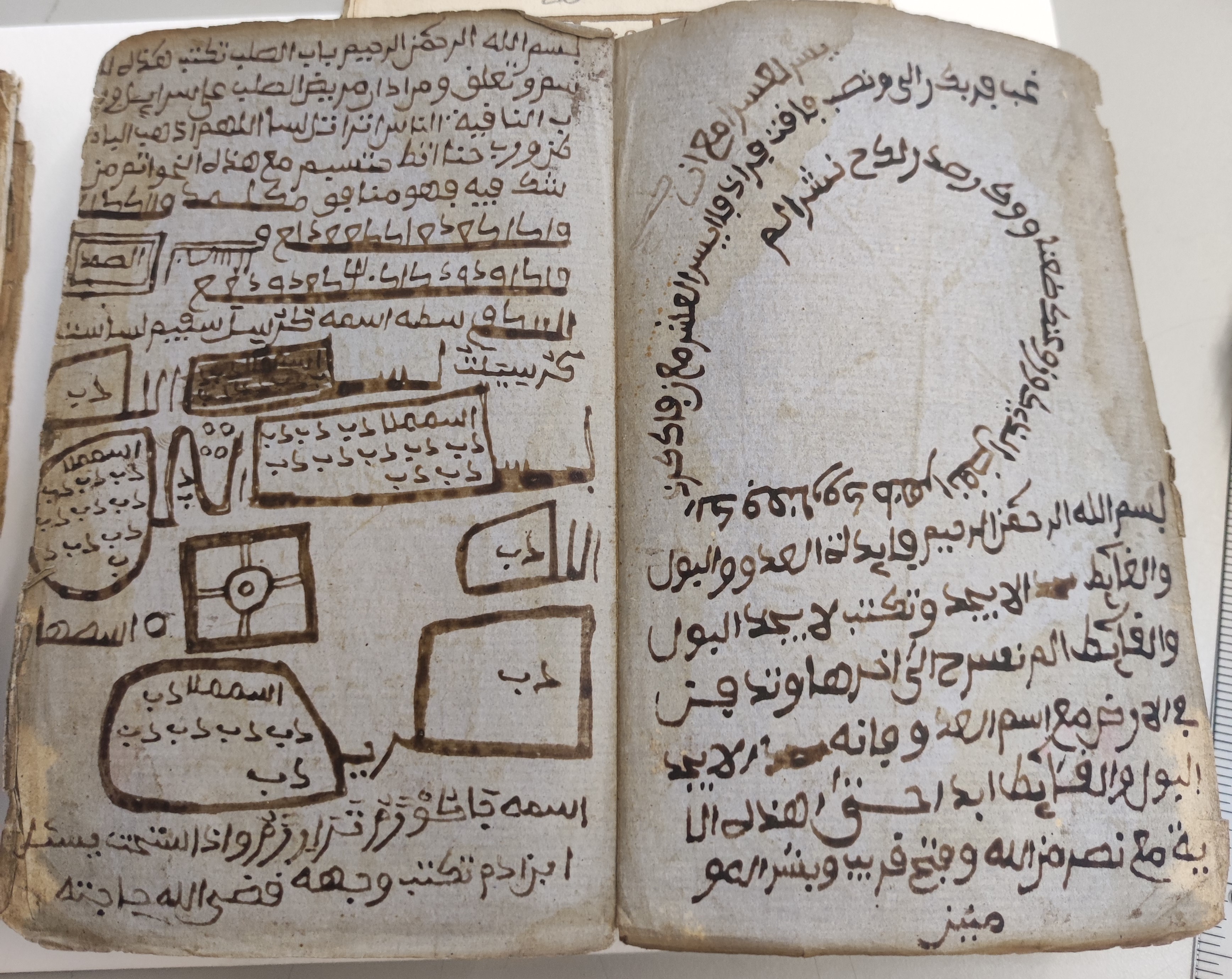
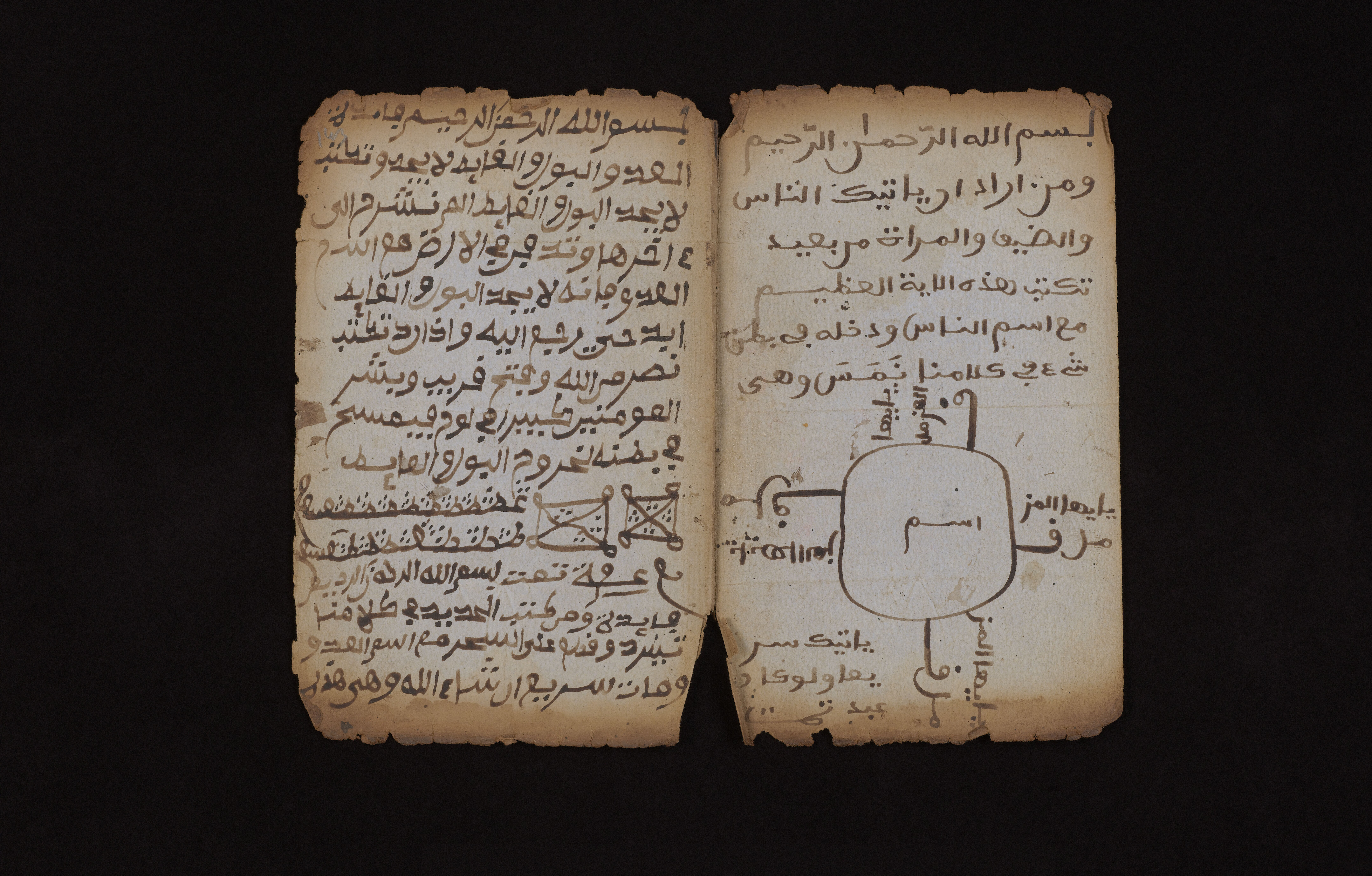
Let’s have another look at the blue folios of WMS Arabic 742, this time in terms of content. Some of the blue pages were used for particularly complex esoteric symbols and magic squares (Figs. 4–6), and we might be tempted to assume that the blue paper was in some way favoured over white or that it had special significance. However, only 6 of the roughly 270 leaves of the manuscripts are made from blue paper, and statistically, their occurrence is almost negligible. Assumptions about significance are therefore tenuous. The scribe’s choice to use the blue folios for the complex drawings may have had more to do with the space available on them than with their colour. The blue folios tend to be larger than the other folios in the manuscript and were folded to fit (I call these ‘bifolia’ in my article). Therefore, more space for drawing was available on them.
It is difficult to say whether the phenomenon of ‘recycling’ (repurposing) paper was common in West African manuscripts in general. Out of the West African manuscripts in the Wellcome Collection, WMS Arabic 742 is the only one with a significant number of ‘recycled’ folios, and they still make up only 14 of the 275 folios in the book. Looking for such folios in manuscripts is not unlike the proverbial search for a needle in a haystack. However, I know of several manuscripts from the digitised libraries of Timbuktu that do contain similar folios. Research into the different kinds of ‘recycled’ paper in West African manuscript culture could help us understand not only the region’s entanglements in colonial-era trade networks but also the continuity of its traditions. West African manuscript culture has sometimes been perceived as an isolated outlier in the global history of written culture. New information helps us better understand its role within this history and better appreciate its relationships with other cultures.
In my research article on the ‘recycled’/repurposed paper in WMS Arabic 742, I have tried to investigate how the writers engaged with the three kinds of ‘recycled’ paper I singled out. In the case of blue paper, this was an extremely difficult speculative undertaking, more so than with ruled or pre-printed paper. The blue paper carries no specific visual elements that could have caught the writer’s eye. In principle, a blue folio enables the scribe’s creativity to exactly the same extent as a blank white folio. Nevertheless, we know that blue writing supports did hold high symbolic significance in certain strands of Islamic manuscript cultures – compare, for example, Jonathan Bloom’s work on the famous Blue Qur’ān, a magnificent ninth-century manuscript, written in gold on dark blue parchment (Bloom, 2015). It is tempting to assign similar significance to the blue paper in WMS Arabic 742. But the evidence is insufficient to definitively link the blue folios in the manuscript with a specific type of content (such as esoteric content). There is no way to know for sure whether the blue paper was chosen purposefully on grounds of aesthetic value or spiritual significance. The paper could just as easily have been chosen based simply on availability. In the case of WMS Arabic 742, the number of blue folios is too small to draw specific conclusions. The manuscript does, however, leave us with interesting questions for further investigation.
References
Biddle, Michaelle (2015), ‘Arbib, Ydlibi and Suru (Hakuri): three Arabic Script Watermarks in Northern Nigerian Manuscripts (end 19th–beginning 20th century)’, in Regourd, Anne (ed.), The Trade in Papers Marked with Non-Latin Characters/Le commerce des papiers à marques à caractères non-latins, Leiden: Brill, 11-33.
Blair, Sheila S. (2000), ‘Color and Gold: The Decorated Papers used in Manuscripts in Later Islamic Times’, Muqarnas, 17, 24-36.
Bloom, Jonathan M. (2015), ‘The Blue Koran Revisited’, Journal of Islamic Manuscripts, 6:2-3, 196-218.
Bongianino, Umberto & Éléonore Cellard (2025), ‘The Pink Qur’an: A Reverse Bibliography’. Journal of Islamic Art and Architecture, 1: 1-2, 83-142.
Bower, Peter (2002), ‘Blues and Browns and Drabs: The Evolution of Colored Paper’, in Stratis, Harriet K. & Britt Salvesen (eds.), The Broad Spectrum: Studies in the Materials, Techniques and Conservation of Color on Paper, London: Archetype, 42-48.
Brückle, Irene (1993), ‘The Historical Manufacture of Blue-Coloured Paper’, The Paper Conservator, 17:1, 20-31.
Burns, Thea (2025), Blue Paper. The Overlooked History of a Drawing, Printing and Writing Material. 1400-1600. London: Archetype.
Coleman, Donald C. (1958), The British Paper Industry: 1495–1860. A Study in Industrial Growth. Oxford: Oxford University Press.
Evans, Joan (1955), The Endless Web. John Dickinson & Co. Ltd. 1804–1954, London: Jonathan Cape.
Gacek, Adam (2009), Arabic Manuscripts. A Vademecum for Readers. Leiden: Brill.
Goodman, Deena (2006), ‘Why is Writing Paper Blue? Colour and Fashion in Eighteenth Century Writing Paper’, in Corcy, Marie-Sophie et al. (eds.), Les archives de l’invention. Écrits, objet et images de l’activité inventive. Toulouse: CNRS–Université de Toulouse-Le Mirail, 537-546.
Kostelnik, Jannis (2026), ‘Recycled Paper in a West African Composite Manuscript from the Wellcome Collection (WMS Arabic 742)’, Zeitschrift der Deutschen Morgenländischen Gesellschaft, 176:1, 15-36.
Krätli, Graziano & Ghislaine Lydon (eds.) (2011), The Trans-Saharan Book Trade. Manuscript Culture, Arabic Literacy and Intellectual History in Muslim Africa, Leiden: Brill.
Ogorodnikova, Darya (2023), Soninke Ajami Manuscripts and Islamic Education. A Reconstruction of Scribal Practices, PhD Thesis, University of Hamburg.
Ogorodnikova, Darya & Khaoula Trad (2025), ‘Palimpsesting or Paper Reuse in Islamic Manuscripts of Islamic West Africa’, in Gippert, Jost et al. (eds.), Palimpsests and Related Phenomena across Languages and Cultures. Berlin: De Gruyter, 475-508.
Vella, George W. (2018), ‘Postal Stationery: Great Britain. Queen Victoria 1837–1901’, Journal of the Malta Philatelic Society 47:3, 2-35.
Weiß, Wisso (1959), ‘Blaues Papier zu Druckzwecken’, Gutenberg-Jahrbuch 1959, 26-35.
Biography
Jannis Kostelnik is a doctoral candidate and former research associate at the Centre for the Study of Manuscript Cultures at the University of Hamburg. His doctoral project, ‘Prayer, Protection, and Plant Medicine: West African Composite Manuscripts from the Wellcome Collection’, focuses on a corpus of late nineteenth-century medical-esoteric manuscripts from different areas within the region, housed today in the Wellcome Collection in London. He has also published on similar manuscripts in the Timbuktu libraries, as well as on West African scripts. Since mid-2026, he holds a position in research management at the University of Göttingen.
jannis.kostelnik@uni-hamburg.de

