The first time I did a backing removal, I was told to use blunted scalpels to peel away the degraded board layers. This worked well enough, but the working angle was very awkward. It was alarmingly easy to dig too deep and punch a hole through the artefact. My hand quickly got tired, and blisters on my fingers were such a common occurrence that I started pre-emptively bandaging them. There had to be a better way to remove backings!
My first successful upgrade was to modified Casselli spatulas. These are thin, flexible steel spatulas that come in a variety of sizes and shapes. I used a whetstone to grind down the flat part of the spatula until it acquired a moderately sharp edge. I did this with two spatulas of different sizes, and they were my favourite backing and tape removal tools for a long time. The flexibility, together with the slight bend of the spatula shaft, made for a much more convenient angle – at least in the short term. Long backing removal sessions still weren’t fun. After a half an hour or so, holding the spatula still became quite uncomfortable. If only it came with an ergonomic handle…
Then, one day, a memory surfaced. When I first started conservation school, a student in the year above me showed me a tool she had made. This student, Jeanne Beaudry Tardif, was in the paper specialisation stream, but her background was in fine art painting. The tool in question was a palette knife – essentially a metal spatula with a wooden handle, used by artists to mix and manipulate paint. Jeanne had sanded down the spatula part for use as a lifting knife. I thought this was very clever. Then Jeanne graduated, and I forgot all about her tool. Until it came back to me one day.
A spatula with a handle! Wasn’t this exactly what I was looking for? Could this possibly work? Only one way to find out!
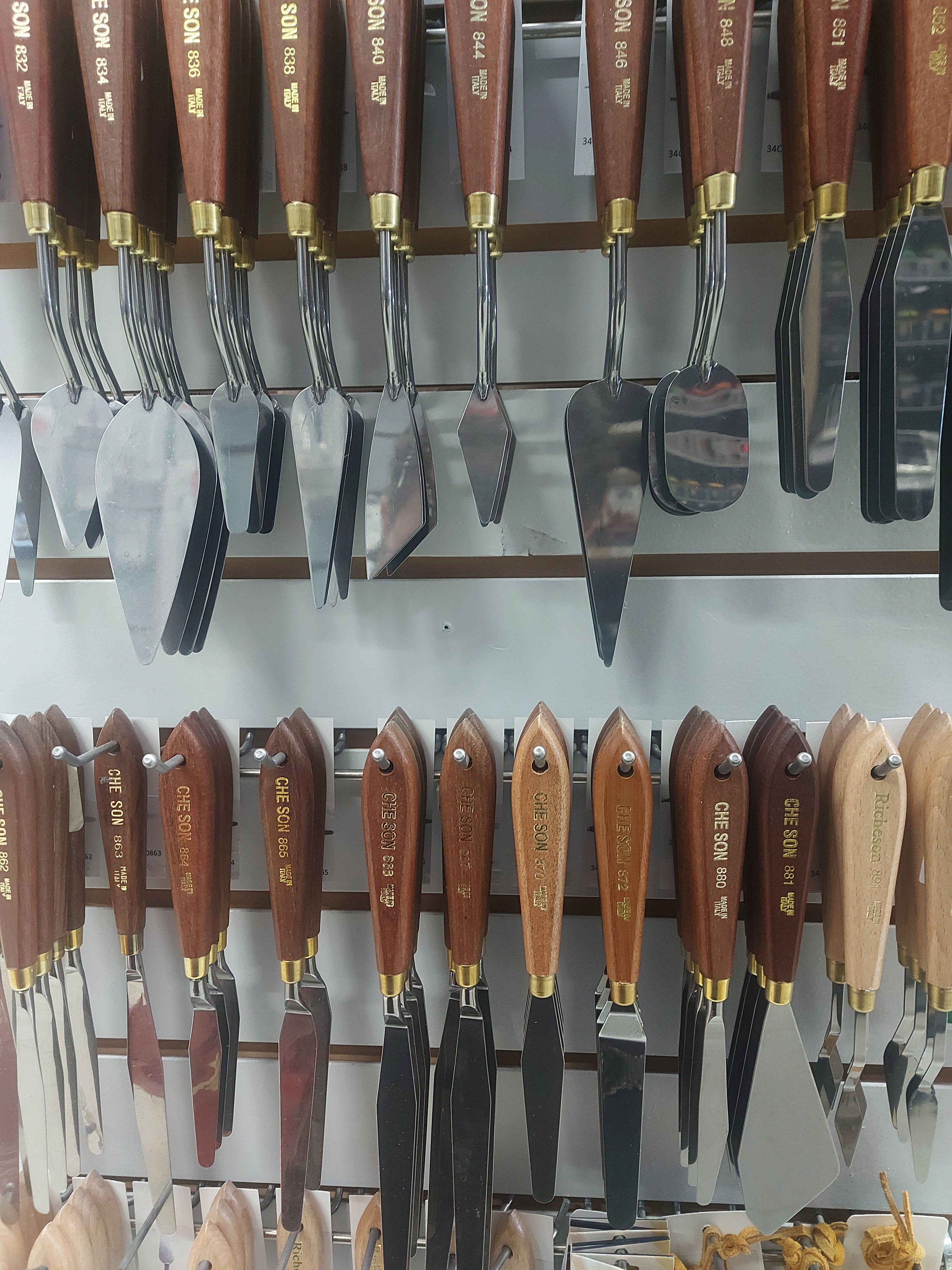
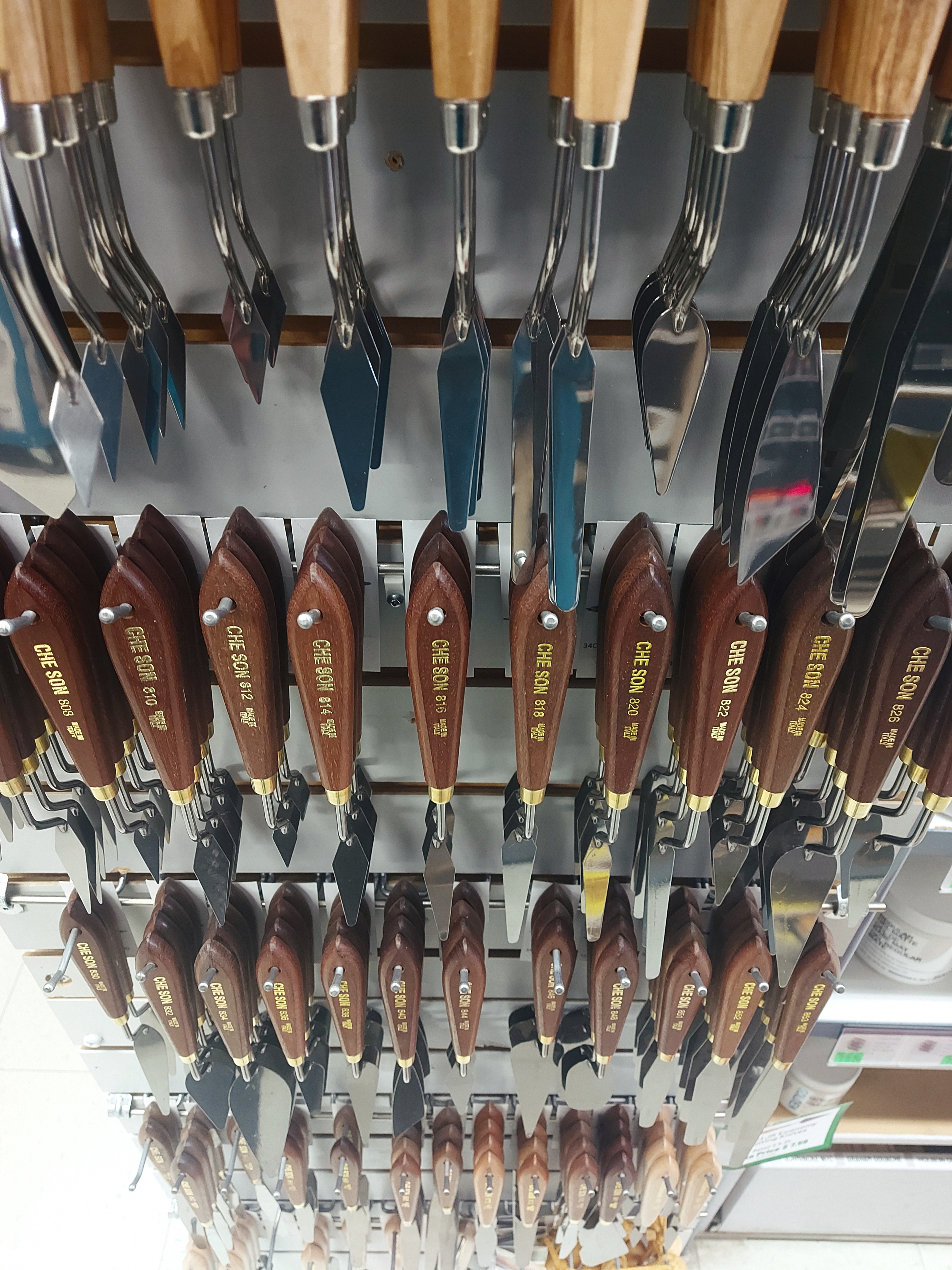
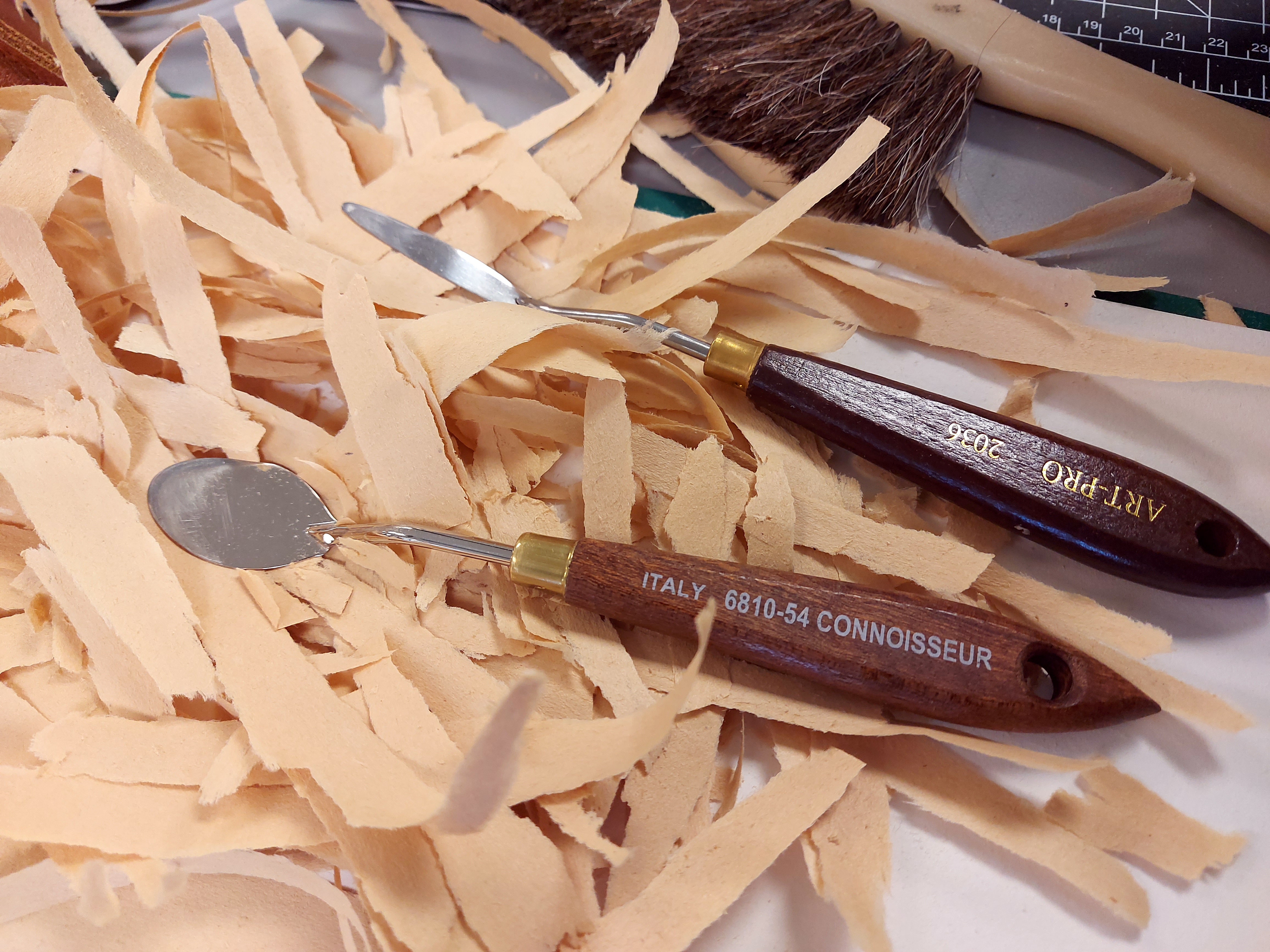
The classic palette knife has a wedge-shaped blade, but art supply shops stock them in a huge range of other shapes and sizes. I found one with a rounded blade and another one that was elongated like a microspatula. I used a whetstone to sand them both down to a moderate edge, just as I had done with the Casselli spatulas. Then I tried them out on a backing removal.
And – what do you know? They worked great! The palette knives became lifting knives. They had a good amount of flexibility, the angle was perfect, and there was a wooden handle! No more cramped fingers from gripping awkwardly shaped metal. Amazing!
These modified palette knives are now my favourite tools for backing removal, tape removal, and just about anything that requires forcefully separating layers. They’ve held up very well, and even after two intense backing removal projects, they show no sign of wearing down. And with so many different blade shapes available, there’s huge potential to create custom tools for highly specific tasks. The only word of caution I have is to stay away from cheap or student-quality palette knives – I’ve found that they’re made from a different metal alloy and don’t have the same flexibility. Artist-quality knives have a lovely spring to them, very helpful for delicate work. Student-grade ones can be stiff and unwieldy.
The funniest thing in all of this is, I’m a painter myself. I have palette knives among my painting supplies, and I do use them. And yet, somehow, years passed before it occurred to me to use palette knives for paper conservation. And that’s with the hint that I got from Jeanne all that time ago, too. Amazing how the most obvious things can sometimes be staring us right in the face, and we still don’t see them. Don’t you wonder what else we might be missing?
All images by Katherine Potapova
Katherine Potapova is a paper conservator based in Edmonton, Alberta, Canada. She graduated from Queen’s University in 2013 with a Master of Art Conservation degree, and was accredited by the Canadian Association of Professional Conservators in 2020. Currently, Katherine does conservation work for the Archives Store and Client Services, a program of the Provincial Archives of Alberta. She also edits articles for The Book and Paper Gathering, paints, writes, and dabbles in many things.
 The Book & Paper Gathering
I use a butter knife i bought from ebay and filed down the edge. That works a treat. Same principle.
LikeLiked by 1 person
I could see that! Great idea – thank you for sharing!
LikeLike