SPOTLIGHT
Where did you study? Where do you work?
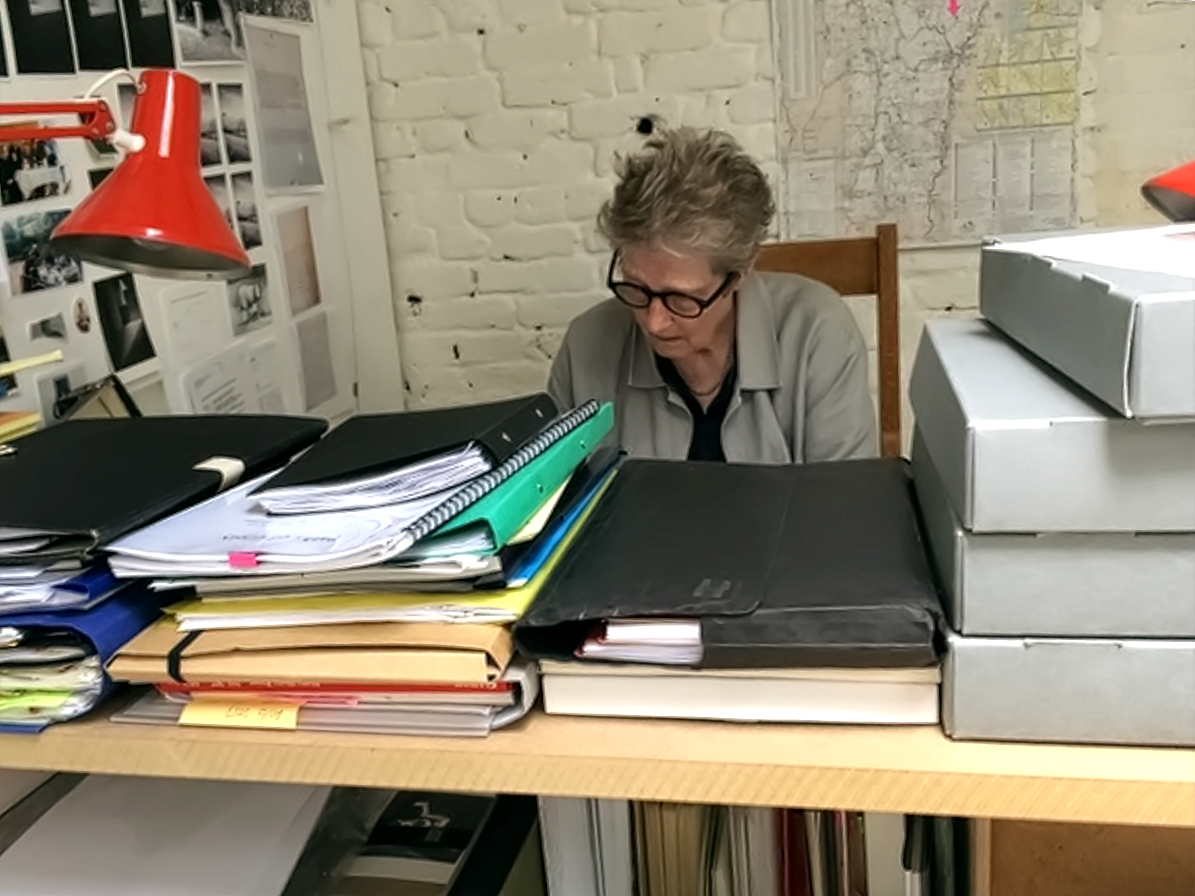
I studied bookbinding at Camberwell School of Arts and Crafts, London, England. After over thirty years of practising, teaching and writing about bookbinding I am currently ‘retired’.
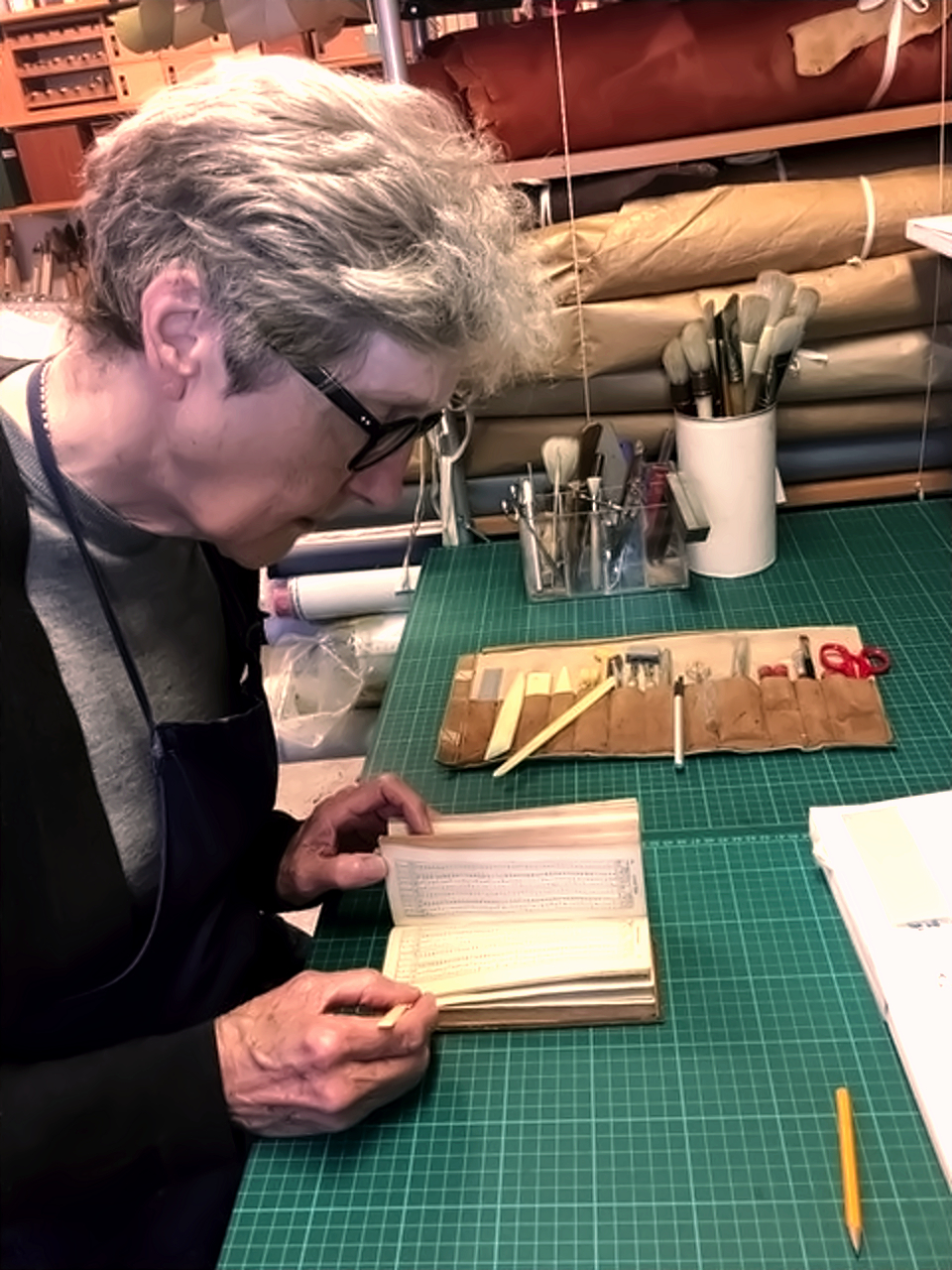
Bone or Teflon? Why?
Bone. It is a natural, recycled material which can easily be filed into different shapes.
Teflon is actually a brand name for a chemical coating (PTFE), rather than a substance in itself; but it is indelibly connected with PFOA (perfluorooctanic acid) which has been banned as a health hazard, so never use it.
Apron or white lab coat?
Apron.
The gloves: on or off?
Off, but very clean, washed hands.
SOFT FOCUS
We’re just warming up! What are you working on right now?
I am in the thinking stage of how to rebind an 1840 craftsman’s book of measuring tables: one board is missing, the other broken off, spine leather broken, but sewing intact. Its long, narrow format – 175 long x 75 wide x 25mm deep – is compounded by the fact that the grain direction of the paper runs the wrong way, i.e. it runs across the page from spine to fore-edge, rather than from head to tail (parallel with the spine) as it should. The grain direction of all machine-made materials in a book should run from head to tail to ensure proper opening and flexing. As a result it does not open well and snaps shut. It’s a fairly typical bookbinding engineering problem which, with sympathetic sensibility, will dictate the binding.
When you tell people what you do for a living, they……….. ?
Have no idea what I’m talking about.
If you could invent one tool for conservation, what would it do?
Wash my brushes.
What conservation technique or treatment are you constantly impressed with? And why?
Detailed condition recording in writing and photography. Basic, but crucial.
What’s the most depressing thing about the conservation profession? What changes would you like to see?
A lack of developed practical skill and historical knowledge, particularly of how books are and were made. This has been due to a devaluation in society at large of the importance of history, and consequently a lack of funding and provision for education and training in many skills vital to preserving that history. The loss of experienced staff and the effective closure by ‘slimming down’ of conservation studios in institutions (which should know better) in the interests of economy (often an excuse for lack of insight) is disastrous – who is to bring on and educate those who come after us? A national college for what might broadly be called ‘craft subjects/skills’ to replace the current, fragmented provision would be a start.
Another source of dismay is the limited choice and availability of good materials now: very often one has little or no choice. This can similarly be due to a loss of certain skills, but the ‘slimming down’ mentioned above contributes to a reduction of demand for certain materials, which in turn means that manufacturers cannot sustain a healthy business and so close…resulting in yet more limited choice.
Perhaps a buyers’ consortium formed from institutions with common material needs might guarantee not only the standard of materials but also guarantee a steady demand and supply?
When I see……….., steam comes out of my nostrils!
People using scalpels for general cutting. People using the wrong scalpel blade. People not changing their scalpel blade frequently.
PATIO LANTERNS
Who are your role models or mentors? Who or what inspires you?
Throughout my life many people have been a role model in one way or another…
Amateur marathon runners inspire me, but not enough to do it myself!
How do you preserve/conserve yourself? What keeps you going?
Reading. Reading.
If not conservation/preservation, what would you be doing right now?
I’d be a retired medical doctor.
If you could invite anyone round for dinner, who would it be? What’s on the menu?
Virginia Woolf, Eleanor Roosevelt, Ella Fitzgerald, George Eliot. Italian food.
LIGHTS OUT………..Z Z ZZZ
What music rocks you to sleep?
The BBC shipping forecast.
People would be surprised that you………..
Like Tamla Motown records.
What’s your secret hobby?
I was going to say that reading was my secret hobby but, as intimated above, it is actually my sanctuary and salvation. So perhaps I should say: walking the course of the lost rivers of London.
You get your kicks by……….. ?
Waking every morning.
What’s your favourite book?
Oh dear! Impossible to choose _ but a very interesting question for an avid reader!
I remember putting down Lampedusa’s The Leopard and thinking “That’s the best book I’ve ever read”, but then I think of To the Lighthouse, Mrs Dalloway, or Dr Zhivago, or Sunset Song, or Memoirs of Hadrian – and others that have completely taken me over in the same way…each book has its own place in your life at a given time perhaps?
Desert island survivor: what conservation tool would you take with you? Why?
Japanese hole punch. Not really sure why, it’s just a perfect little ‘machine’.
Thanks for sticking with us to the end! Last question: if you could give just one piece of advice to a new conservator, what would it be?
Curiosity is your guide and your teacher. Listen to your doubt.
 The Book & Paper Gathering
Would love to know why using a scalpel for general cutting is a no no. What would she use instead and why?
LikeLike
Great interview. Ms. Lindsay has a wonderful dry humor. I’m an American so have not had the pleasure of listening to the BBC shipping forecast. I can imagine it however. The Japanese hole punch is a wonderful choice, I love mine! It’s beautifully machined and just the right heft. But alas not enough to crack open a coconut. I will add the books that Ms. Lindsey has mentioned to my ever growing list of “must reads”. Unfortunately it seems that Jen (if I may) is the among the last of high caliber conservationists.
LikeLike
Thank you for your VERY generous comment: glad you liked the interview. Don’t know where in USA you are, but I have read of someone in Maine following the BBC Shipping Forecast…
Hope you find an engaging book amongst those I mentioned – it’s a very personal list of course so not To everyone’s liking.
Many thanks again, and apologies for the very tardy reply.
jen
LikeLike
Dear Roger, if I may,
First, my apologies for not replying to you sooner. I expected that question, but just didn’t check the site enough. Fortunately, one of the editors alerted me to it.
I do not use scalpel blades for general cutting purposes as firstly, being thin and not terribly securely attached they can break easily under pressure and be dangerous when they snap. Secondly, being flexible they do not lend themselves to accurate cutting. Thirdly, they lose their edge quite quickly. Many people do not change their scalpel blades sufficiently regularly, if at all.
The most common scalpel combination seems to be a 10A blade (worse, an 11 blade) on a standard 3 handle, but the 10A has too oblique an angle for anything but the tip to be in contact, which blunts very quickly, so 99% of the blade is unused.
I do use scalpels, but for specific tasks: a 25 blade on a 4 handle for edge paring paper, and for paring the edge of leather joints and doublures. For delicate/fine cutting I use a 15A blade on a 9 handle. The 15A/9 is actually my favourite combination as it transmits direct feeling/contact to the hand – you feel at one with what you are doing. On the rare occasion I have to cut sewing stitches I use a 12 hooked/curved blade on a 3 or 9 handle.
So – for general cutting I use an Xacto handle (equivalent: Swann Morton ACM 1 or Jakar 7333), shaped like a pencil, which has a collar which you unscrew and screw to secure the blade in a slot.
I use no.16 Xacto blades (I have an old stock) which are slightly thicker and more rigid than scalpel blades. They can be stropped on a leather strop to keep their edge a bit longer, which cannot really be done with scalpel blades, so they are more economic.
This is just my thinking on it. I’m sure others may disagree, but it seems to me that part of one’s self-respect as a maker is to respect one’s tools, and to choose and use the right tool for the right task.
LikeLike
The interviewee was heart warming and clear. I read a translation of The Leopard for the first time and really enjoyed it. I had been looking for a way of saying thank you again to Jen. She presented me with a facsimile of Dürer’s Apocalypse when we were both at Roehampton. I continually use the book in my teaching and continue to be moved by her present. I continue to learn how to sharpen blades. Thank you Jen, Allen Fisher.
LikeLike
Message from Jen Lindsay:
How good to hear from you Allen, especially after such a long time! Thank you for you characteristically kind and generous comments, and I’m pleased that you seem to have returned to fulfilling creative work again (full-time now?).
AND…gratified that you have discovered The Leopard: it’s one of the few novels that have been successfully transferred to film, with a surprising and engrossing portrayal of the Prince – by Burt Lancaster of all people, a hugely underrated actor.
Active bookbinding now has an almost negligible place in my life, although I still maintain a strong interest in books/bookbinding/conservation generally. The loss of long-term programmes such as we had at Roehampton, which unfortunately coincided with the closure of other extended courses (e.g. Guildford), has been pretty disastrous for passing on experienced skills and techniques to new generations – as I said in the ‘Soft Focus’ section of my replies in the Q&A above – but I suspect bookbinding is not the only craft discipline which is so afflicted. It is always fascinating when I re-acquaint with ex-students to see what they are doing now – not all bookbinding, but for many it provided an essential grounding in thinking and doing.
Some organisations are trying to plug the gap by offering funding for ‘masterclass’ training/education, which is proving essential, but is no substitute for an extended, fundamental education. I am not averse to new ideas and ways of doing things, but unless you have a firm grounding/understanding of where they come from/what lies behind you can flail around for a long time before experience takes over and compensates to some extent. Anyway, anyway…I digress!
Thank you again, for your steady work and words…
Best wishes
Jen
LikeLike