By Viviana Molinari
When treating a leather binding, one of the main challenges is preventing colour change or darkening, especially if adhesives are involved. A promising solution I’ve found is using cyclomethicone D5, suggested by my colleague Alessandro Sidoti, head of the conservation workshop at the Biblioteca Nazionale di Firenze, who learnt about it from Gabriele Coccolini (Opificio delle Pietre Dure di Firenze).
I first tried out cyclomethicone D5 several years ago while working on eighteenth-century book bindings made with very delicate, light-colored leather that readily absorbs moisture. Contact with wheat starch paste would have led to noticeable darkening along the edges, but cyclomethicone D5 turned out to be a real game-changer.
What is cyclomethicone D5?
It’s a silicone-based product used in the cosmetics industry. In conservation, it’s useful mainly due to its ability to temporarily waterproof a material. Silicone-based solvents are volatile – they are thought to evaporate completely from surfaces, leaving no residues. They repel water, but their polarity is so dramatically low that they fall completely outside the Teas solubility triangle and cannot dissolve fats or oils. In fact, they are sometimes referred to as non-solvents. Silicone-based solvents are already used for safely cleaning acrylic paint films and for cleaning natural history specimens, such as feathers and bones, where the silicone serves to protect surfaces from absorbing chemicals during cleaning. The same properties make them ideal for use on leather, as they don’t alter its natural composition.
I have used cyclomethicone on many types of leather from various centuries. In my experience, cyclomethicone does not change the texture or colour of the leather. Just a few brushstrokes are sufficient, and the material becomes waterproof almost immediately. It is easy to use and does not need dilution or special preparation. The results are very promising, and I hope to see more research into the uses, properties and limitations of this product in the future.
Practical tips for use
(The photographs illustrating the following procedure were taken during a recent treatment on two volumes with a full leather binding belonging to the Biblioteca San Francesco della Vigna di Venezia. The two volumes, both from the fifteenth century, had very similar bindings: full goatskin, with wooden boards and blind decorations. They also had remnants of clasps.)
First, always test a small hidden area at least one day before the actual treatment to ensure compatibility (Figs. 1, 2). In my experience, the leather always returns to its original colour by the next day, but always test to be safe.


Figs. 1 & 2 – Testing cyclomethicone on the leather before treatment (left) and after the evaporation (right). Photography by Viviana Molinari; courtesy of the Biblioteca San Francesco della Vigna di Venezia.
Once confirmed safe, apply the product directly to the areas that need to be adhered or treated. You can use any type of brush.
If possible, apply on both the grain (Fig. 3) and the flesh side (Fig. 4). However, I have had treatments where I could not lift the leather too much; in these cases, it was enough to make several passes from the grain side.
To achieve good waterproofing, the material should be soaked through with cyclomethicone, as shown in the images.


Figs. 3 & 4 – Application of the cyclomethicone on the grain side of the leather (left) and application on the flesh side (right). Photography by Viviana Molinari; courtesy of the Biblioteca San Francesco della Vigna di Venezia.
To take full advantage of the waterproofing effect, the area should be pasted out (Fig. 5) and adhered immediately after the application. Cyclomethicone evaporates at room temperature; the higher the temperature, the faster it evaporates. It seems to evaporate at the same rate regardless of the type of adhesive used; however, I have found it most useful with wheat starch paste. Without cyclomethicone, wheat starch paste causes the leather to darken more than the other adhesives because of its higher water content. I am not aware of any safety concerns related to fumes from the evaporating solvent (cyclomethicone is widely used in cosmetic products). However, this could be a good area for further research.
Keep in mind that if the volume requires bandaging (Fig. 6), for example to secure the adhesion of the spine, it is best to remove the bandages after a few hours instead of keeping them on overnight. This is to allow the solvent to evaporate properly. The evaporation of the solvent also slows down whenever the leather is covered (for example, with blotters). If the leather is kept covered overnight, it will still be permeated with the solvent and will look very dark when uncovered the next day. However, it will still return to its original colour after some additional evaporation time (about 24 hours). Over the years, I have used cyclomethicone on many types and colours of leather, and I have never yet seen a permanent colour change.
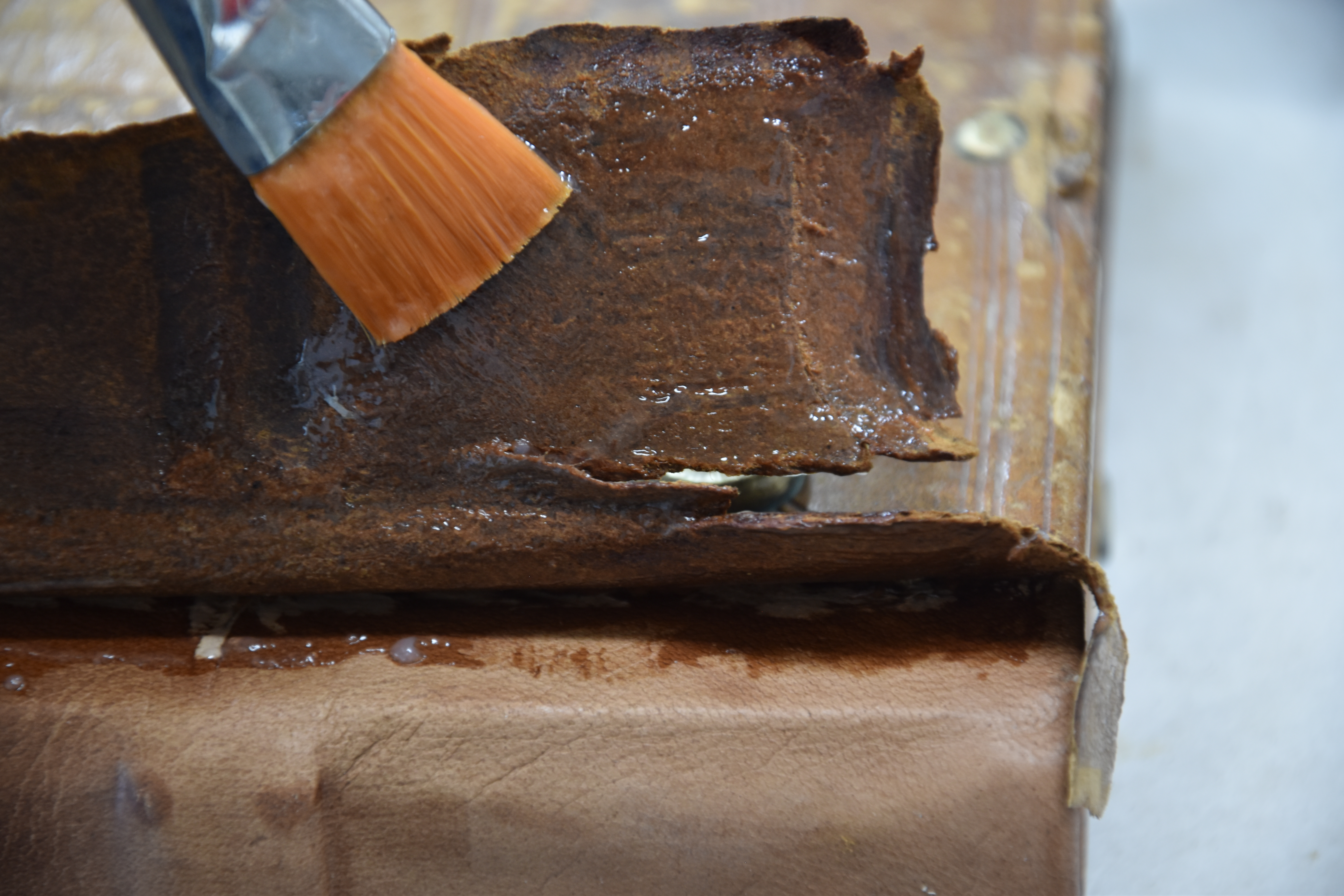
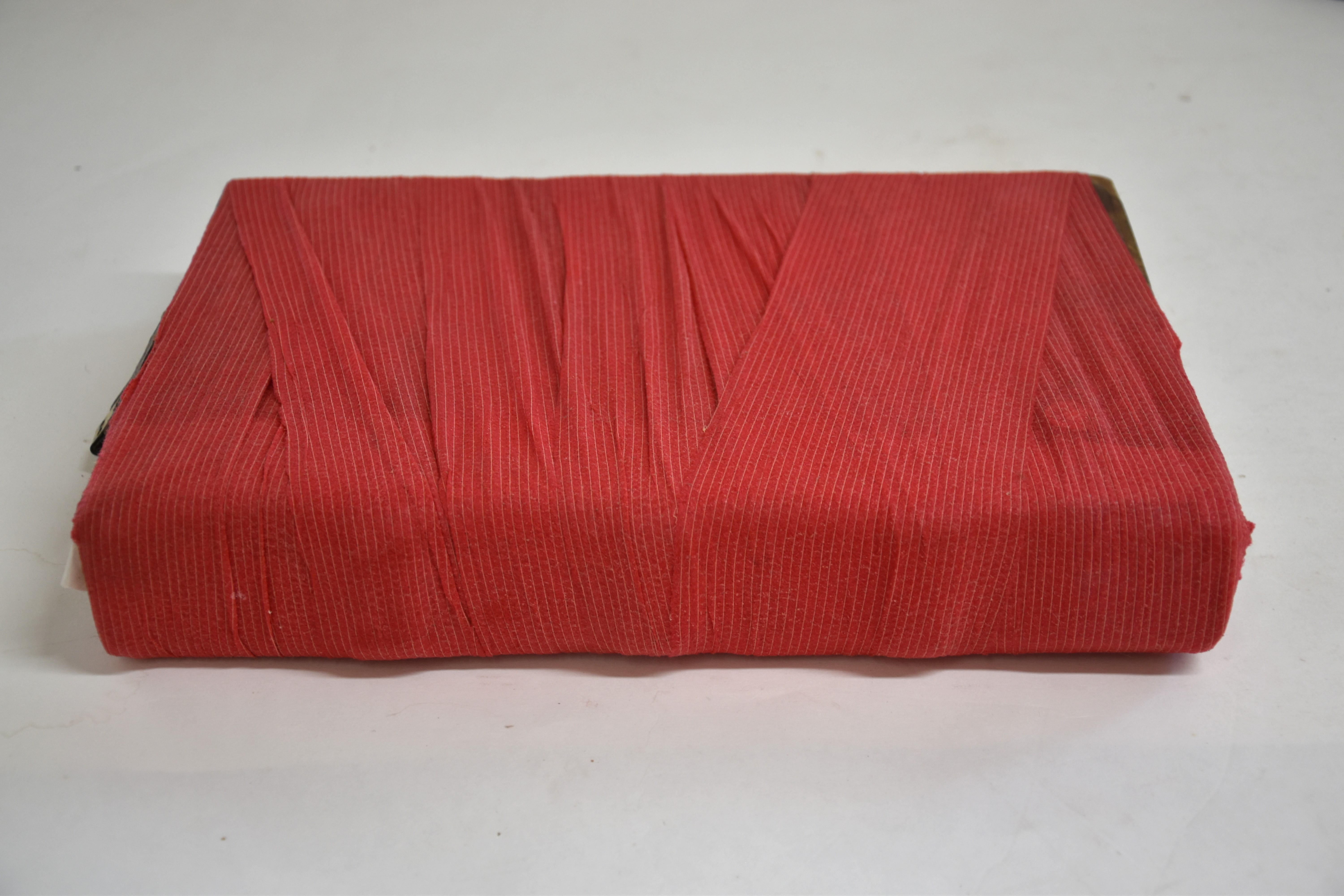
Figs. 5 & 6 – Spreading the wheat starch paste (left) and bandaging the spine (right). Photography by Viviana Molinari; courtesy of the Biblioteca San Francesco della Vigna di Venezia.
Concluding thoughts
Using cyclomethicone D5 is simple – almost trivial – but it yields excellent results (Figs. 7, 8). It helps maintain the leather’s integrity, keeping it clean, stable, and protected throughout the conservation process.
Based on my experience and that of other colleagues who use it, there is no visible change in the colour or texture of the leather after treatment. We did not notice any change even when revisiting the treated volumes several years later. Existing studies on conservation treatments of various materials1 suggest that cyclomethicone evaporates completely and leaves no residues. However, more research in that area would be welcome.
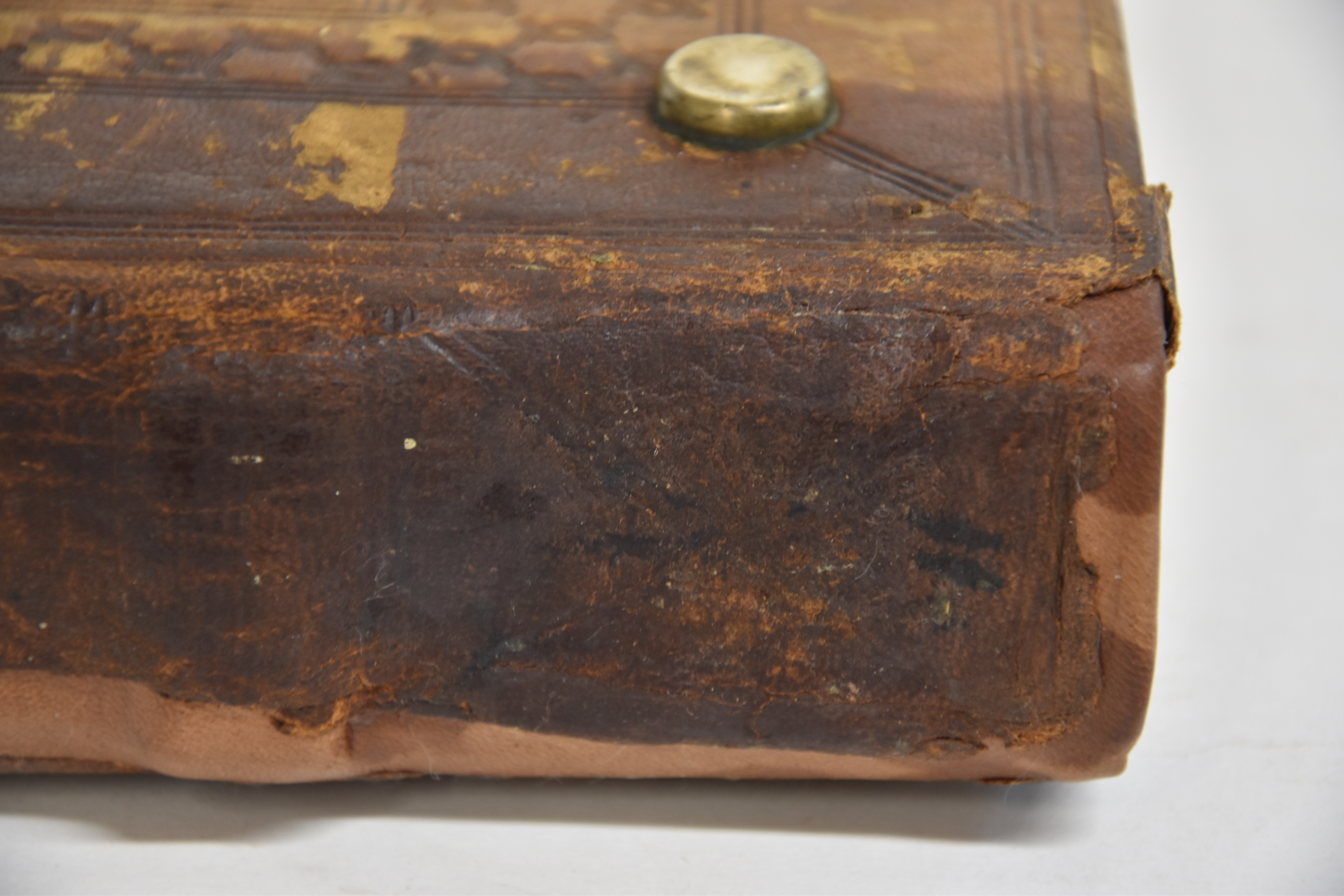
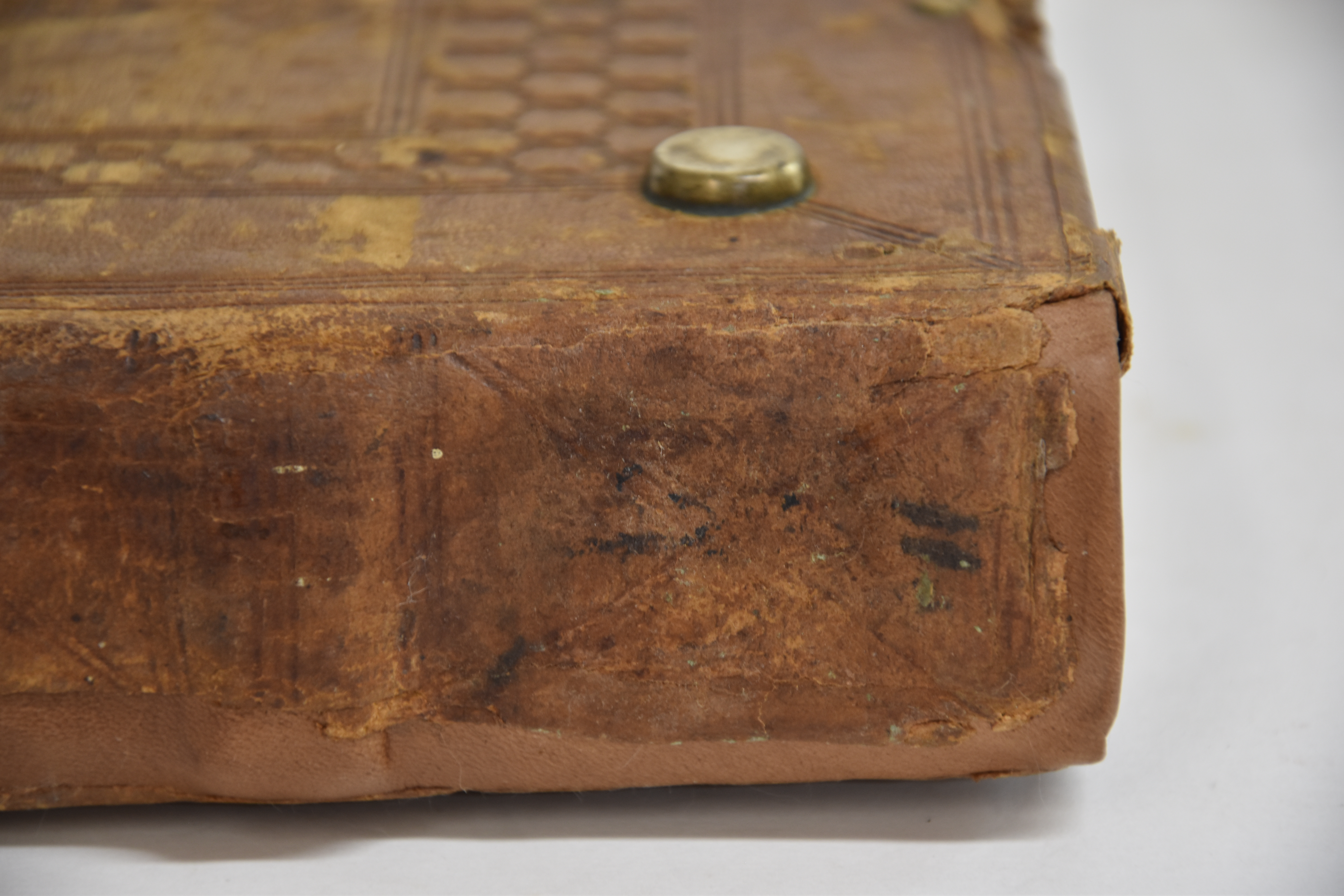
Figs. 7 & 8 – The spine is still saturated with cyclomethicone (left) and the spine after the treatment (right). Photography by Viviana Molinari; courtesy of the Biblioteca San Francesco della Vigna di Venezia.
Footnotes
1 Proprietà ed esempi di utilizzo di materiali siliconici nel restauro di manufatti artistici. Vol. 1, a cura di P. Cremonesi, Ed. Il Prato, Collana Arte, 2016.
Biography
A book and paper conservator, Viviana Molinari runs her own studio and has been working as a freelancer for Italian libraries, archives and private clients for 25 years. She has graduated from the Botticino Restoration School in Italy and has gained valuable internship experience in France at the National Library and National Archives in Paris, as well as in the United States at the Folger Shakespeare Library in Washington, D.C.
 The Book & Paper Gathering
Thank you for this excellent discussion. I have been testing then using D5 on acid decay bookbinding leathers with students and interns at my studio for the last 7 years. It was suggested l test this substance to make leathers temporarily hydrophobic during water-based and specific solvent treatments to remove previous repairs and spine labels on rare books. The results have been consistently excellent if used sparingly.
LikeLiked by 1 person
Thank you Karen for your comment. The use of D5 as a temporary waterproofing for leathers really works, and this allows for a much broader application during restoration — not only to prevent the darkening of the leather but also for other uses, as you mentioned. We look forward to further studies and insights!
LikeLike
Its use on acid decay bookbinding leathers is very interesting — I’d love to learn more about it!
LikeLike
Sure, happy to discuss further my email is bcsbindery@gmail.com.
LikeLike
Hi Karen, I’ve sent you an email, thank you so much for your kind availability!
LikeLike
From where is this cyclomethicone D5 available ?
Alex
LikeLike
Hy Alex, I work and live in Italy, so I buy from national suppliers such as Cts or Bresciani, but I’m sure it can be easily purchased from any restoration products supplier. For example, I also found it at Kremer. As I wrote in the article, a very interesting aspect is that it’s already ready to use and for the application I’ve proposed, no dilution is needed.
LikeLike
Fascinating, I had never heard of using silicone-based solvents in this way. I will try to get my hands on some soon to try it out, it seems like a true game-changer! Thank you for this post.
LikeLike
Hi Simon, thanks so much for your kind words. I’m really glad this product can be helpful in our everyday work. We hope to read more studies on this topic in the future and to discover more ways to apply it, not only for leather darkening.
LikeLike
I just recieved my Cyclomethicone D5 delivery today and I,m very excited to try it out. If it works the way you described, it would be extremly helpful! Thank you for this post!
LikeLike
Hi Anne, thanks for your reply. As I mentioned in my earlier comments, I think we can still discover more ways to use this product. Have a good day!
LikeLike
Hello Viviana,
Thank you for sharing! I am a conservation student planning to do some research on Cyclomethicone D5 on paper. I just wanted to see if you perhaps have tried using it on paper or if you have any information related to this topic.
Thank you so much!
LikeLike
Hi hc, thank you for your interest! So far, in addition to leather, I have used cyclomethicone D5 to temporarily hydrophobize paper (instead of, for example, cyclododecane) when wet treatments are needed and pigments risk becoming soluble. In suppliers’ technical datasheets it is also recommended for cleaning greasy substances, but I have never used it in that way. Here is a link to an Italian video by the chemist Borgioli, who explains several aspects of cyclomethicone D5 very clearly. At the end of the video, he also mentions that ECHA (European Chemicals Agency) has banned the use of cyclomethicone D4 and has imposed restrictions on other cyclomethicones (widely used in the cosmetics industry) because they are persistent and bioaccumulative substances. An exemption has been made for conservation, so it can still be used, since the quantities we use are, by comparison, very minimal and well controlled.
Good luck with your work!
LikeLike
Thank you so much for this interesting post! I can’t wait to try it and share it with my French colleagues!
LikeLike