A long-awaited reference book for book conservators – Conservation of Books – was published by Routledge in April 2023. The Gathering has tracked down the busy independent conservator and editor of the new book, Abigail Bainbridge, to find out more about the book’s development, objectives and challenges.

When did you come up with the idea of the book?
The fundamental idea of it is so obvious, especially with the other ‘conservation of’ books out there, that I’m not really sure it was mine. We all wanted this book to exist, right? I figured someone else would do it, though, until the publisher came to me and asked me to do it. The specifics of the book concept came together as I worked out the proposal. I still had to submit a formal proposal for peer review and publisher approval, and that happened over autumn 2019 through to spring 2020.
How was the chapter structure formulated?
I knew I wanted to cover book structures, materials and degradation, ethics/theory, and techniques, so the sections were straightforward. I puzzled out the book structure chapters for a long time, though, because it wasn’t obvious whether to arrange them geographically, culturally, chronologically… Nothing fits into a tidy taxonomy. I really didn’t want it to be, like many other texts, something that looks at European structures first/primarily and treats everything else as an afterthought. However, it was also not possible to dedicate an equal amount of words to every type of structure, because for some, we know much more than others. Equally, I simply couldn’t find conservators available to write on some of the topics.
Another difficult issue was how to write about techniques. There would never be enough space to write a step-by-step for enough treatments that it would be exhaustive, although I know there are some readers who would have liked that. The only way to make it work was to look at the idea of what’s possible and have a discussion on why or when to use certain techniques, as well as what’s not done so commonly anymore, and use it more as a resource for considering treatment options.
In general, there wasn’t enough space in one book to put everything that could be said on each subject. Even making it two or three volumes wouldn’t necessarily have solved that problem. Instead, I thought it was best to keep it succinct as an overview, a snapshot of all the information together in one place, with bibliographies to point the reader towards more in-depth information for each. In some chapters, though, I think the authors were able to really get everything in that they wanted to and produce what we think is the most robust text out there on the subject in English; for example, the chapters on Chinese bindings and on European printing inks.
Once the book was commissioned, how easy was it to find the specialist conservators to write?
It was hard! I wanted people from as wide a geographic range as possible, especially to flatten treatment bias (what’s common practice in one area may not be so in another). I’m American and live in the UK, so many of the conservators I know are American or British. I wanted conservators rather than academics where possible so that all of the chapters would be informed by an implicit understanding of the objects and the conservation issues. I wanted people who really knew their subject or could put solid research into it, but at the same time people who were reliably strong writers who would keep up with deadlines and work collaboratively with the rest of the authors. I also wanted people at the top of their fields, and it was important to me to include newer conservators who would do a great job but weren’t yet so well known. Some of the people I wanted weren’t available, or left partway through the project, and for some niche areas, there weren’t that many options of people with the necessary experience.
I would like to take this chance to say that there are many other people who could have been great choices, but I didn’t know them well personally, or didn’t know at the time that they’ve been working in a particular subject area, or I just didn’t think of them at the time!





Did it help that conservators were being approached in the lockdown period, and so potentially had more time to take on a chapter commission?
I approached a lot of them before the pandemic, actually, because I needed names for the proposal and wanted to make sure that I had enough people theoretically on board and that the project was viable. I’m sure the pandemic both helped and made things worse: some people knew they would have the time, but some knew they wouldn’t be able to access resources or were already overwhelmed with kids homeschooling or adjusting to working from home. I myself had the same workload for my business as before, plus small twins who wanted a lot of attention, and so I did a lot of work at night.
How long did it take to pull together all the chapter text?
Most of the authors had a year from November 2021 to get the text together. You probably won’t be surprised to hear that they didn’t all finish their chapters on time! Next we edited it and added to it until July 2022. From August 2022 to this February was the copyediting, typesetting, cover design, etc.
What was your favourite part of the whole project and the one you are most proud of?
Just doing it feels like enough most days! There were a lot of nice parts along the way. Getting to know some new conservators was lovely. And after years of supervising MAs and reading student papers, giving feedback, and the work largely not getting picked up again, it was so rewarding to work on something that could be shaped, polished and published, and just seen through all the way to the end. Now that it’s done, the best part is hearing from people about the moments it’s already been useful to them, and I’ve used it myself to look things up!
What was the most challenging or frustrating part of the project?
It was a bit terrifying when people were late with submissions or corrections, because first I was worried about having enough material to actually have a book at all, and then I was worried about having to cut chapters that were already written but needed revision. I had nightmares about it! That said, I don’t think you do a project with 70 people where things all happen on time, and there was a pandemic to boot, so it was all predictable and it came together in the end.
Was there anything you wished you could have included, but weren’t able to?
Oh yeah. And if you ever run into Lauren Moon-Schott and need an ice breaker, ask her about the pesticide research that came out slightly too late to be included. But that’s what the second edition is for, right?
Were there any surprises during the process, or did anything turn out differently from what you were expecting?
I can’t think of any!
Now it’s published and available, have you got any other ‘books on books’ you’d like to work on in the future?
I’d like to do one about the plants used in bookbinding… I’m looking for a botanist to work with on it.
And without whose support could you not have brought this book project together?
There are a couple of pages of acknowledgements in the book, and I really meant every word of it. Having said that, my husband Tristram is always my biggest support, and a constant one.
Author images credited to Abigail Bainbridge, Alexa McNaught-Reynolds, Élodie Lévêque, Georgios Boudalis, Mito Matsumaru, Marian Angela Silvetti, Lang Ngo, Samantha Cawson, Tamara Ohanyan, Tuuli Kasso and William Bennett.
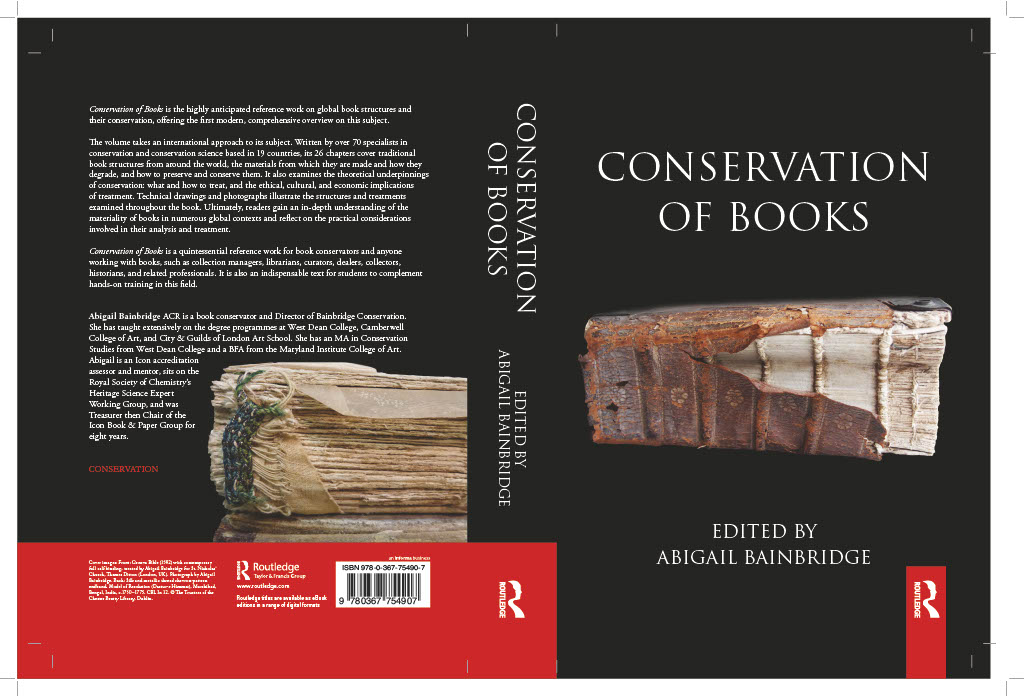
Front cover: Geneva Bible (1592) with contemporary full calf binding, treated by Abigail Bainbridge for St. Nicholas’ Church, Thames Ditton (London UK). Photograph by Abigail Bainbridge.
Back cover: Silk and metallic thread chevron-pattern endband.
Model of Resolution (Dastur-e Himmat), Murshibad, Bengal, India, c.1750-1775.
CBL In 12. © The Trustees of the Chester Beatty Library, Dublin.
Routledge is an imprint of the Taylor & Francis Group, an informa business
 The Book & Paper Gathering